Buying property in Costa Rica is safe and straightforward when the right people handle each step. Foreigners can own titled property on the same terms as Costa Ricans, but the process works differently from the U.S. or Canada: there is no title insurance by default, a notary public closes the sale, and the deposit should never go straight to the seller. Here is how a well-run purchase works, from the first offer to the day your name appears in the National Registry.
Who does what
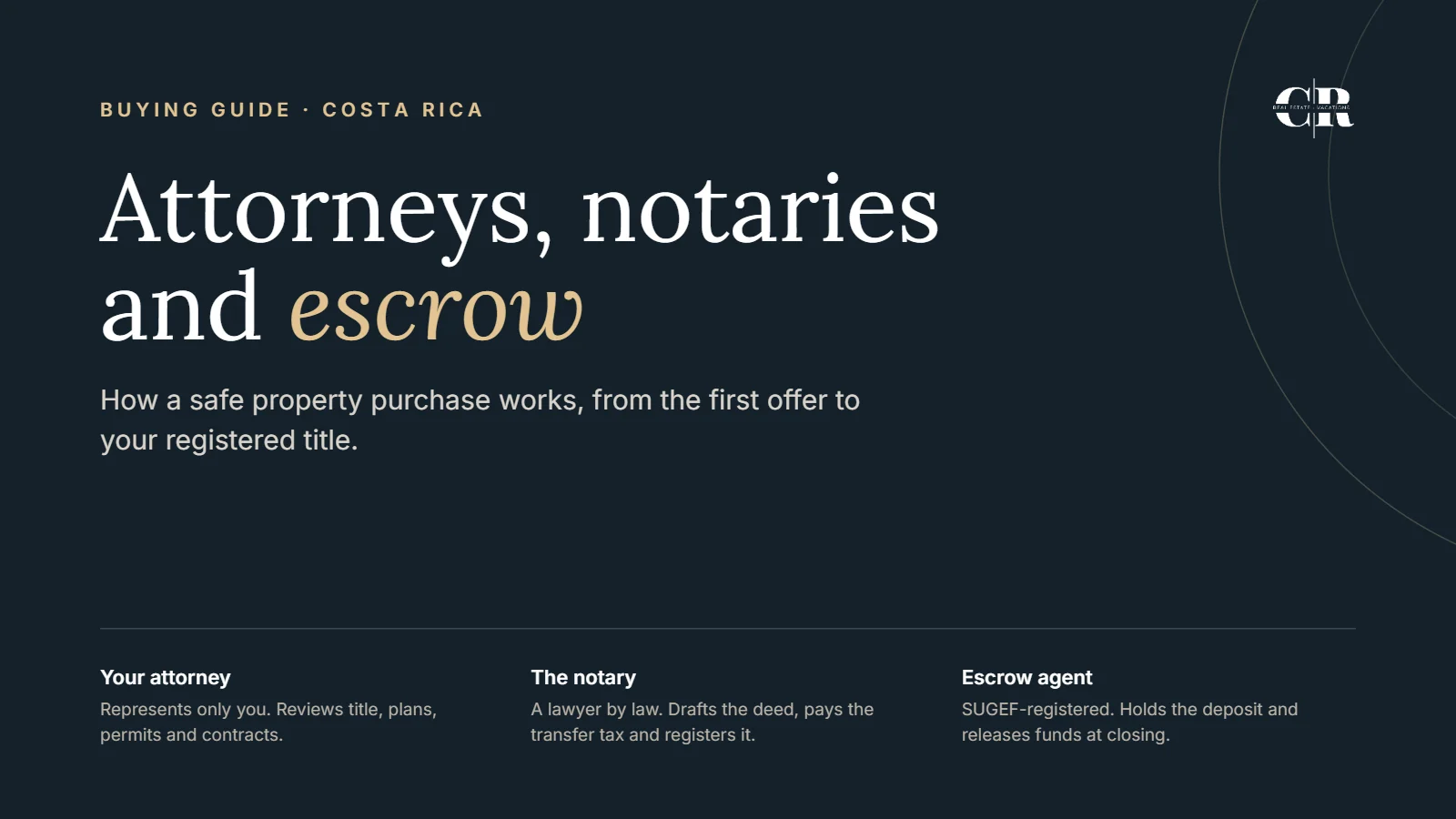
- Your own attorney: reviews the title, the survey plan, permits and contracts, and protects your interests. Hire a lawyer who represents only you and has no connection to the seller, the listing agent or the developer.
- The notary public: in Costa Rica only a lawyer can be a notary. The notary drafts the transfer deed, collects the transfer tax and stamps, files the deed with the Registro Nacional and answers for its legality. In a cash purchase the buyer usually chooses the notary; in a bank-financed purchase the bank’s notary handles the closing.
- The escrow agent: holds your deposit and the balance of the price until the deed is signed. It must be registered with SUGEF, the financial supervisor.
- Your broker: negotiates the deal, coordinates the timeline and keeps everyone on the same page. A good broker never asks you to send money to their own account.
The purchase, step by step
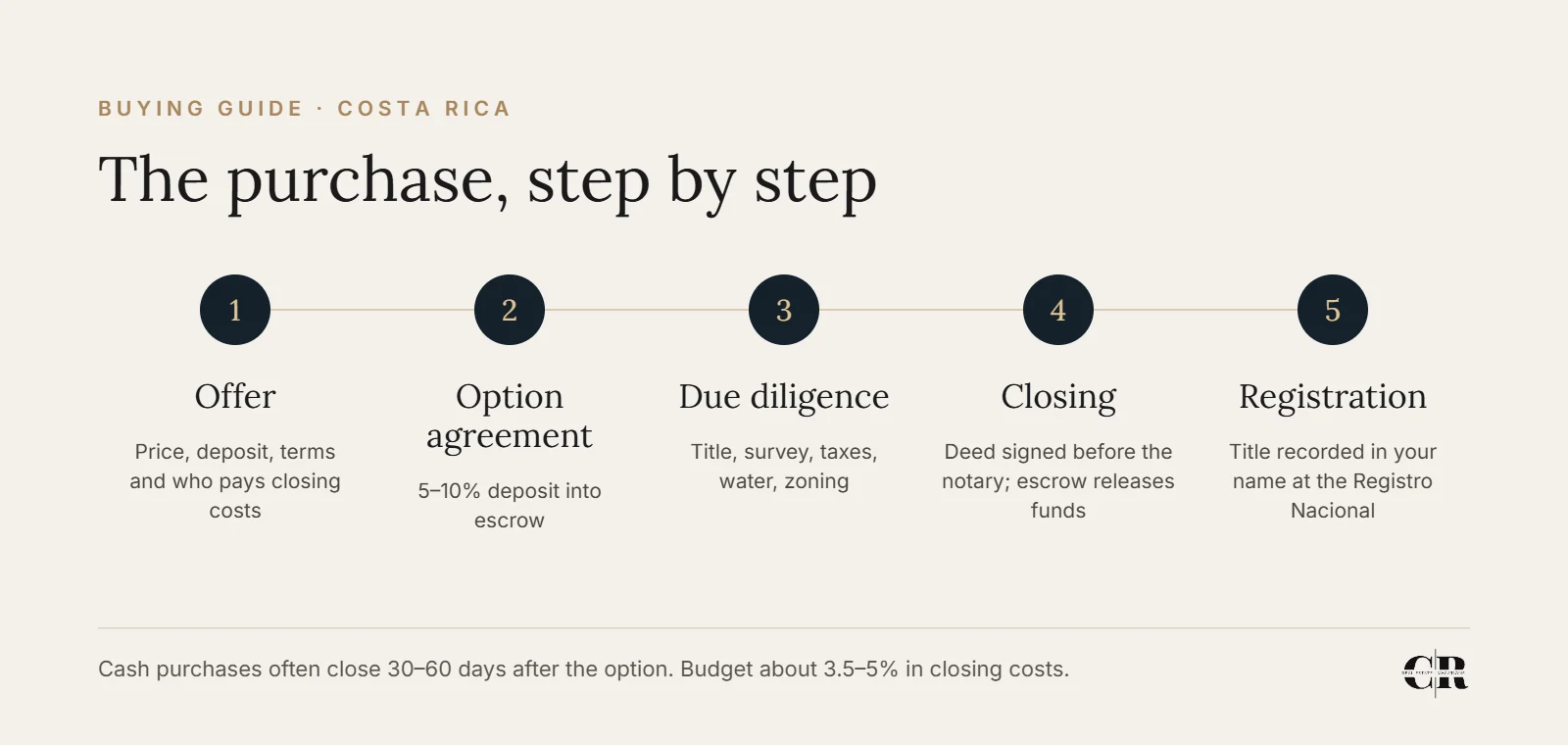
- Offer. Price, deposit, closing date and conditions are agreed in writing, including who pays which closing costs.
- Option to purchase agreement (opción de compra). It fixes the price, the deadline and the conditions. The deposit is commonly 5% to 10% and goes into escrow. If the buyer walks away without a reason allowed in the contract, the deposit is usually lost, so the contract should allow you to cancel if due diligence uncovers a problem.
- Due diligence by your attorney. See the checklist below.
- Closing. Buyer and seller (or their representatives) sign the deed before the notary, and escrow releases the funds to the seller only when the deed is signed.
- Registration. The notary pays the transfer tax within 15 business days and files the deed electronically. The transfer is final once it is recorded in the Registro Nacional, so ask your attorney for the registration certificate in your name.
A cash purchase with clean title often closes 30 to 60 days after the option agreement is signed.
Due diligence checklist
- Title (folio real) in the Registro Nacional: owner, boundaries, fiscal value and any mortgages, liens, easements, lawsuits or embargoes.
- Survey plan (plano catastrado): a licensed surveyor confirms it matches the lot on the ground.
- Municipal taxes: unpaid taxes stay with the property, so get a certificate that they are current.
- Water: a water availability letter from the local ASADA or AyA is required to build. This is why master-planned gated communities are so valuable on the Guanacaste coast.
- Zoning and restrictions: land use, forestry and conservation limits, and hazard maps.
- Maritime zone: the first 50 meters from the high-tide line are public, and the next 150 meters are held under municipal concessions rather than titled land, with special rules for foreigners. Your attorney must review any concession property carefully.
- Condominiums and HOAs: bylaws, fees, rental rules and that the condominium regime is properly recorded.
- Sellers that are companies: confirm who has authority to sign and that the company is current on its corporate filings.
How escrow works in Costa Rica
Escrow is the safest way to move money in a Costa Rican purchase. The agent receives your deposit and the balance, verifies that the conditions are met and releases the funds only at closing. Before you send anything:
- Check that the agent is registered with SUGEF under Costa Rica’s anti-money-laundering law (Law 7786, articles 15 and 15 bis). SUGEF registration is not an endorsement, so also ask for references.
- Ask for a written escrow agreement stating the release conditions, what happens if the deal falls through and the fee. Fees are often around 0.25% of the price or a flat fee of about $1,000.
- Plan for compliance checks. Banks and escrow agents must verify the source of your funds. Expect to wire from an account in your own name, show where the money comes from and sign a sworn statement. Large transfers can be held for several days, so send funds well before closing.
Closing costs
Who pays what is negotiable, so agree on it in writing in your offer. As a reference:
- Transfer tax: 1.5% of the higher of the sale price or the registered fiscal value.
- Registry fees and stamps: roughly 0.5% to 0.8%.
- Notary fees: set by the Bar Association’s fee scale (about 1% for most homes), plus 13% VAT.
- Escrow: about 0.25% or a flat fee.
In total, buyers usually budget about 3.5% to 5% of the price. One more detail: if the seller is not a Costa Rican tax resident, the buyer must withhold 2.5% of the price and pay it to the tax authority. Your notary handles this, but make sure it is in the contract.
Protect your wire transfer
Real estate wire fraud usually starts with an email that looks like it comes from your attorney or escrow agent, with “updated” bank details. Always confirm wire instructions by phone with a number you already know, never only by email, and be suspicious of any last-minute change. Send a small test transfer first if you are unsure.
Frequently asked questions
Can one attorney represent both buyer and seller? The notary who signs the deed acts for the transaction, but you should have your own attorney looking after your interests. Hiring the seller’s or developer’s lawyer saves little and can cost a lot.
Do I need to be in Costa Rica to close? No. With a power of attorney prepared by your lawyer, you can sign from abroad.
Is title insurance available? It is not standard, but some international insurers offer it. A thorough title review by your attorney is the main protection.
Should I buy through a company? It can make sense for some buyers, but it adds annual filings and costs. Ask your attorney and accountant before deciding.
When you buy with me, I introduce you to independent attorneys and SUGEF-registered escrow agents, and I coordinate the process from the offer to the registration of your title. Read our guide to buying as a foreigner and our financing guide, or contact Leo with your questions.
Explore homes for sale: Hacienda Pinilla real estate, Reserva Conchal homes and all gated communities in Guanacaste.
General information as of November 2026, not legal or tax advice. Rates and rules can change; confirm the details of your purchase with your attorney.