 by
Many buyers tell me they want a home right on the sand. In Costa Rica, the first thing to understand is the maritime zone (zona marítimo terrestre), because the land closest to the ocean usually can’t be owned the way a normal property can. Here is how it works, what changes for foreign buyers, and how to tell whether oceanfront property in Costa Rica is titled land or a concession.
The 200-meter maritime zone
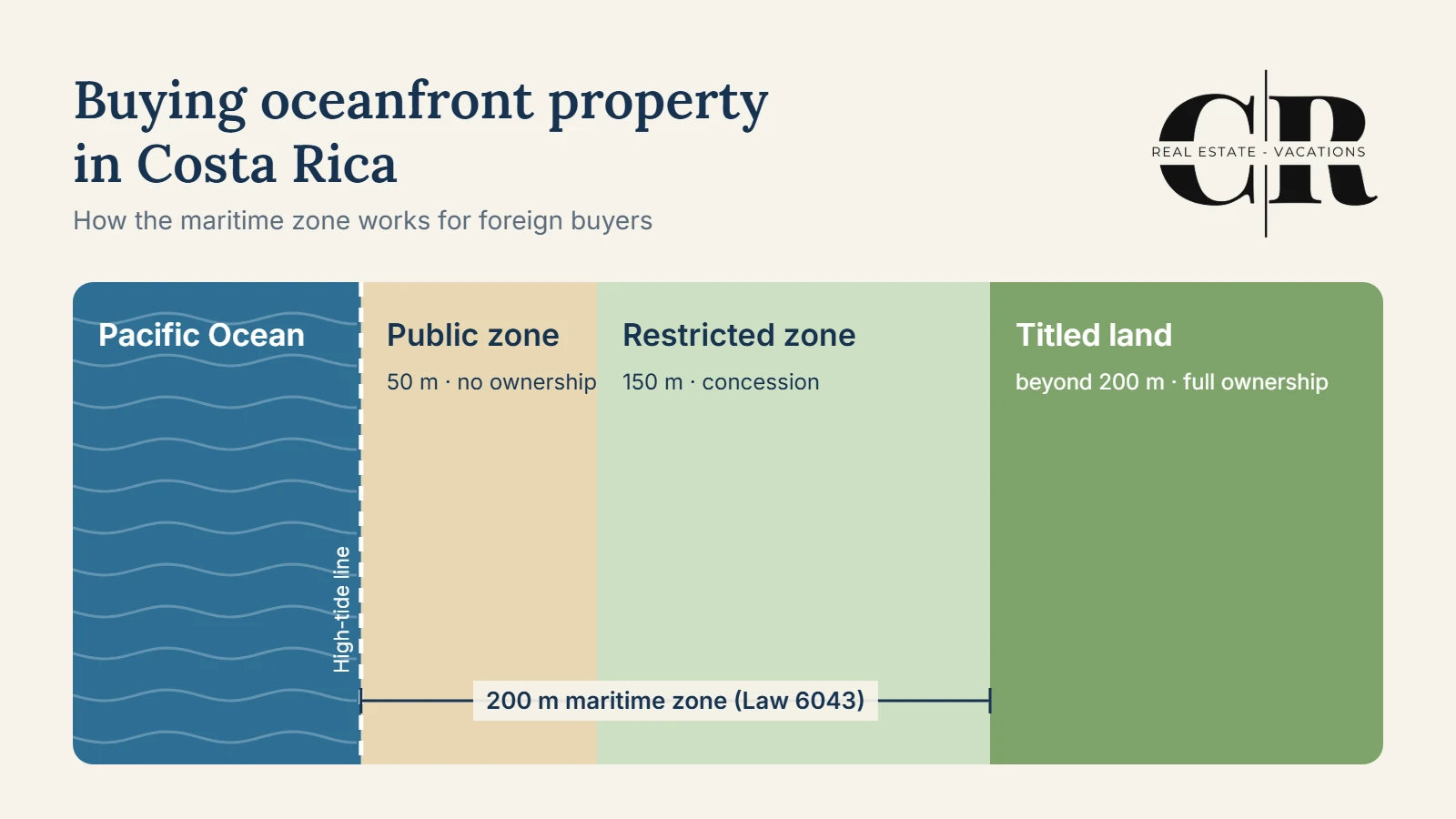
Under Law 6043, the first 200 meters inland from the ordinary high-tide line belong to the State. They are divided into two parts:
- Public zone (first 50 meters): open to everyone. Nobody can own or build there, and mangroves and estuaries count as public zone whatever their size.
- Restricted zone (next 150 meters): it can’t be sold as titled land, but it can be used through a concession granted by the municipality, with oversight from the Costa Rican Tourism Institute (ICT), once the area has an approved coastal zoning plan (plan regulador).
Beyond those 200 meters, land can be titled and registered in the National Registry like any other property. There are exceptions, such as private titles registered before the law and declared urban coastal areas, which is why every oceanfront listing has to be checked on its own.
Titled land vs. concession
| Titled land | Concession in the maritime zone | |
|---|---|---|
| What you get | Ownership of the land, registered in the National Registry | The right to use and build on public land for a set term |
| Term | Indefinite | 5 to 20 years under Law 6043, renewable (up to 50 years in Papagayo) |
| Foreign buyers | Same rights as Costa Rican citizens | Limits apply (see below) |
| Annual cost | Property tax of 0.25% of the registered value | An annual fee (canon) set by the municipality as a percentage of the appraised land value: up to 3% for housing and 4% for tourism use |
| Selling | Freely transferable | Needs prior approval from the municipality and the ICT |
| Financing | Local banks and US-style lenders | Possible with state banks, but fewer options |
What foreign buyers need to know
- Titled land: foreigners can buy with the same rights as Costa Ricans, in their own name or through a company.
- Concessions under Law 6043: Article 47 does not allow concessions to foreigners who have lived in Costa Rica for less than five years, or to companies where more than 50% of the capital belongs to foreigners. In practice, foreign buyers either partner with Costa Rican shareholders or buy titled land just behind the zone.
- Avoid shortcuts: putting a concession in someone else’s name to get around these rules is risky, and transfers that break them can be void. Work with an independent Costa Rican attorney from the start.
- One concession per person: the law limits concessions per person, including spouse and minor children.
Península Papagayo: a different regime
Península Papagayo is part of the Gulf of Papagayo Tourism Project, about 1,658 hectares managed by the ICT under its own laws. Most of the land there, including the area around the Four Seasons and the Andaz, is held under concessions rather than titled land, but the rules differ from Law 6043:
- The ICT grants the concessions, not the municipality.
- Foreigners can hold them directly, and companies must be incorporated and domiciled in Costa Rica.
- Terms can reach 50 years, with renewals.
- Transfers need prior approval from the ICT board, and the law allows state banks to lend against the concession and its buildings.
Before buying on the peninsula, ask for the concession contract, the remaining term, the annual fee and the master association rules. See current Papagayo properties for sale.
Reserva Conchal, Hacienda Pinilla and Playa Flamingo
Most homes and homesites in these communities sit behind the maritime zone on titled land, which keeps ownership simple for foreign buyers while staying minutes from the beach. Amenities right on the sand, such as beach clubs, can sit inside the zone. I confirm the legal status of every property before you make an offer.
Checklist before you make an offer
- Registry and survey: get the National Registry certification and the cadastral plan (plano catastrado). They show whether the property is titled or a concession, and where it sits relative to the high-tide line.
- For a concession: check the remaining term, the annual fee, that payments are current and that the permitted use (residential or tourism) matches your plans under the zoning plan.
- Purchase structure: confirm how you can hold the property as a foreigner before you sign.
- Financing: many international lenders only finance titled property, so ask early.
- Closing: use an independent attorney and escrow. Read how a safe purchase works in Costa Rica.
Bottom line
Oceanfront living in Costa Rica is very possible, but “beachfront” can mean titled land a short walk from the sand or a concession inside the maritime zone. For most foreign buyers, titled ocean-view property just behind the zone is the simplest path. Concessions can work well, especially in Papagayo, when you understand the terms before you buy.
Read the step-by-step guide to buying as a foreigner, browse homes in gated communities or contact Leo to review a specific oceanfront property.
Information as of November 2026, based on Law 6043, the laws and regulations of the Gulf of Papagayo Tourism Project, and public sources. Rules and fees vary by municipality and property. This is not legal advice; confirm with an independent Costa Rican attorney.